ISO 2025-W47
Week begins: Monday, November 17, 2025
Calendar
| Date | Zodiac day | Events |
|---|---|---|
| Mon, Nov 17, 2025 | ♏ 26 | β1 Tuc —  4 4.4 — Southern Autumn β2 Tuc — 5 4.5 — Southern Autumn |
| Tue, Nov 18, 2025 | ♏ 27 | β3 Tuc — 5 5.1 — Southern AutumnC17 / NGC 147 —  9 9.3 — Northern Autumn |
| Wed, Nov 19, 2025 | ♏ 28 | Finest NGC 6 / NGC 185 · MCG 8-2-10 / C18 / NGC 185 — 10 10.2 — Northern AutumnM110 — 9 8.5 — Northern AutumnSchedar (α Cas) —  2 2.2 — Northern Autumn — in the Milky Way |
| Thu, Nov 20, 2025 | ♏ 29 | 🌑 New Moon — 06:47:16 UTC M31 — 3 3.4 — Northern AutumnM32 — 8 8.1 — Northern AutumnDiphda (β Cet) — 2 2.0 — Tropical AutumnC1 / NGC 188 — 8 8.1 — Arctic Autumn |
| Fri, Nov 21, 2025 | ♏ 30 | C56 / NGC 246 / Finest NGC 15 / NGC 246 · Skull Nebula — 8 8.0 — Tropical AutumnC62 / NGC 247 — 9 8.9 — Tropical AutumnFinest NGC 13 / NGC 253 · Sculptor Galaxy / C65 / NGC 253 · Sculptor Galaxy — 8 7.9 — Southern Autumn |
| Sat, Nov 22, 2025 | ♐ 1 | ♐ Sun enters Sagittarius — 01:35:35 UTC Finest NGC 7 / NGC 281 · PacMan Nebula — 7 7.4 — Northern Autumn |
| Sun, Nov 23, 2025 | ♐ 2 | C70 / NGC 300 — 8 8.1 — Southern AutumnCih (γ Cas) — Var 2 2.2 1.6–3.0 — Northern Autumn |
Weekly Solar-System Ephemeris
Snapshot: Week begins November 17, 2025, 00:00 UTC.
(-90° to +90°; defaults +45°, 21:00 LAT)
| Body | ☉︎ | ☽︎ | ☿︎ | ♀︎ | ♂︎ | ♃︎ | ♄︎ |
|---|---|---|---|---|---|---|---|
| Ecliptic | ♏︎ 24°53′ β −0°00′ | ♎︎ 19°12′ β −2°46′ | ♐︎ 2°41′ β −0°36′ | ♏︎ 12°36′ β +1°09′ | ♐︎ 9°00′ β −0°33′ | ♋︎ 25°06′ β +0°07′ | ♓︎ 25°16′ β −2°25′ |
| Observing |  | -7.2 | ☉︎ | ☉︎ | ☉︎ | -2.4 | 0.8 |
| Rise | 07:15 | 04:14 | 07:59 | 06:08 | 08:32 | 20:43 | 14:30 |
| Set | 16:45 | 15:00 | 17:04 | 16:16 | 17:26 | 11:54 | 02:03 |
Extended targets:
| Body | ⚳︎ | ♅︎ | ♆︎ | ♇︎ |
|---|---|---|---|---|
| Ecliptic | ♈︎ 2°35′ β −12°24′ | ♉︎ 29°38′ β −0°12′ | ♓︎ 29°32′ β −1°22′ | ♒︎ 1°38′ β −3°46′ |
| Observing | 8.3 | 5.6 | 7.7 | 14.6 |
| Rise | 15:39 | 16:52 | 14:34 | 12:28 |
| Set | 02:20 | 07:48 | 02:27 | 21:10 |
β = ecliptic latitude (+ north, − south).
Rise and set are Local Apparent Time for the selected latitude.
Naked-eye observing uses the Sun’s altitude at the selected Monday observer time: Daylight (Sun ≥ −0.833°), Civil twilight (−0.833° to −6°), Nautical twilight (−6° to −12°), Astronomical twilight (−12° to −18°), and Night (below −18°).
Solar Glare identifies a body too close to the Sun when the sky-state rule does not already supersede its naked-eye classification.
The Sun’s observing status uses this same five-state sky classification.
Planet Finder
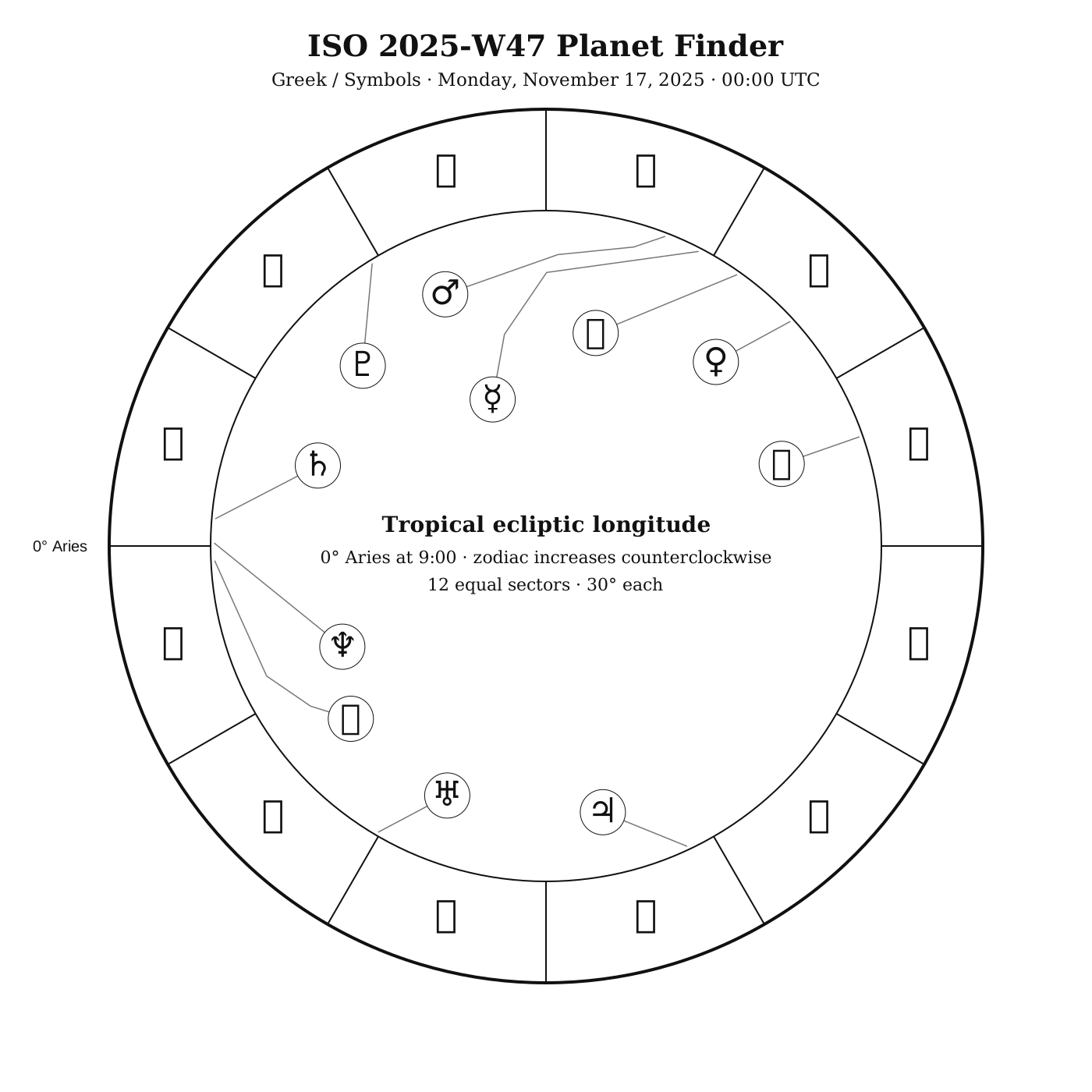
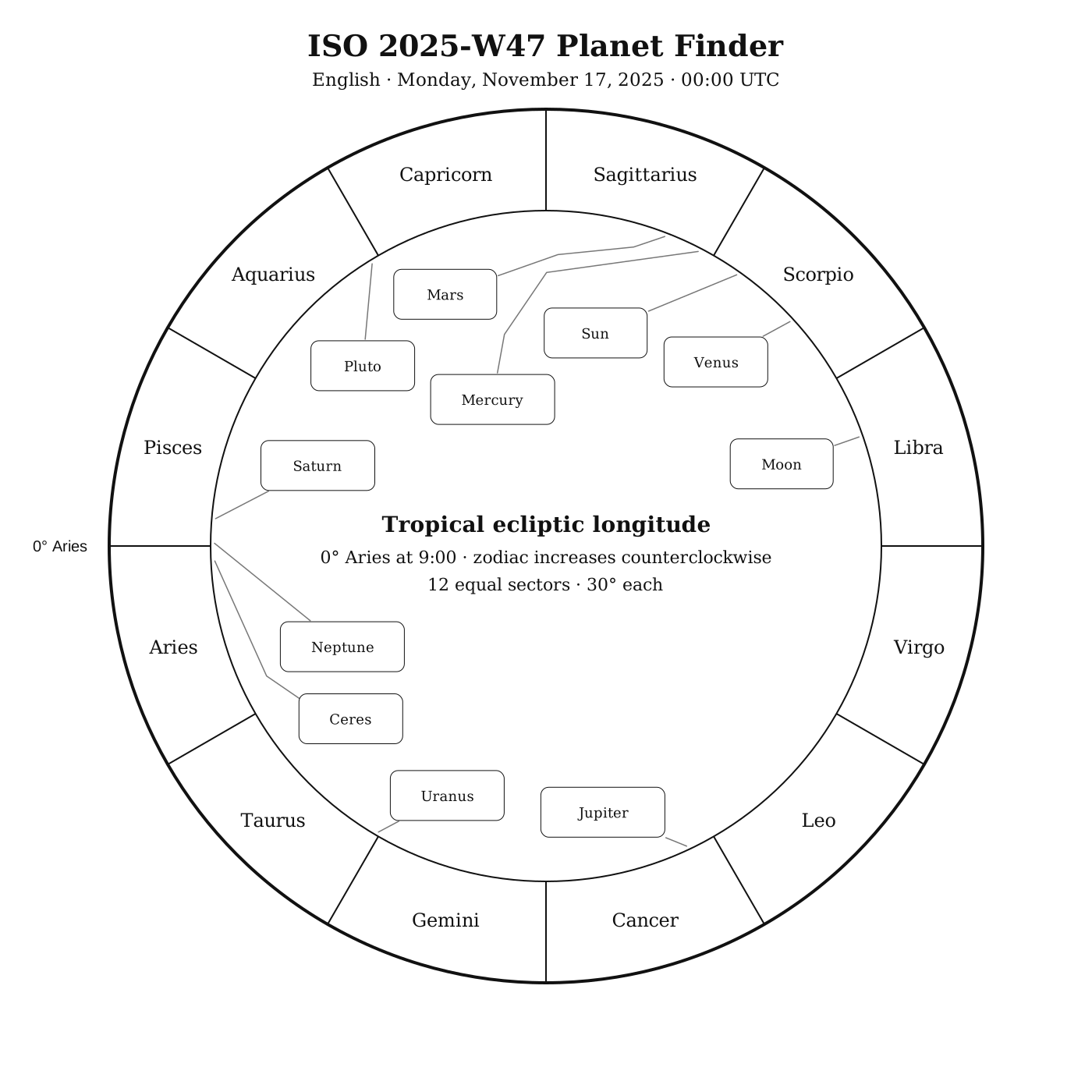
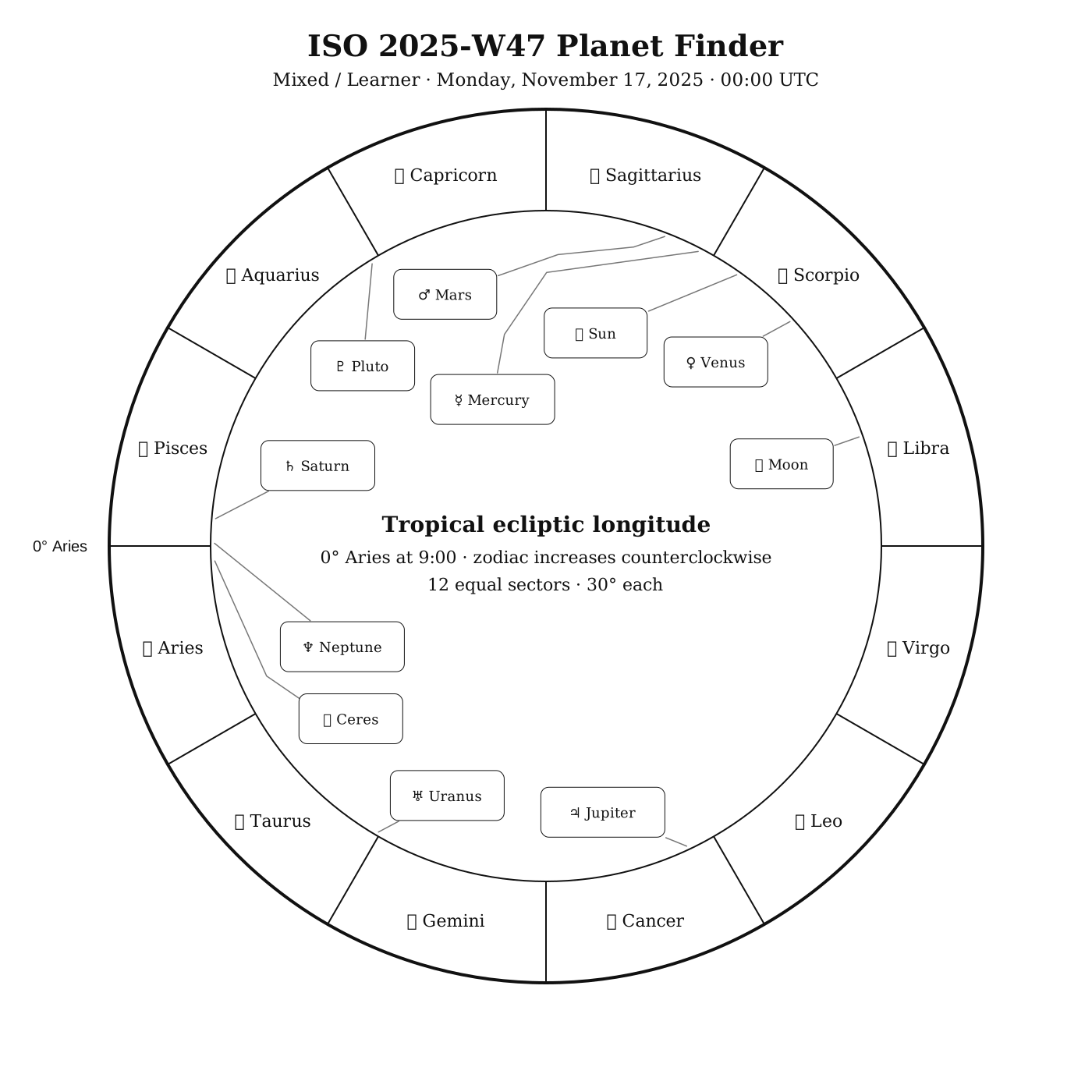
Sky Notes
Kilroy: Sky Notes · generated 2026-10-23 19:36:48 UTC
ISO 2025-W47 runs from November 17 through November 23. Mercury is about 0.1° in ecliptic longitude from Dschubba in Scorpius. Mars is about 0.8° in ecliptic longitude from Antares in Scorpius.


Naked eye: 🌑 New Moon — 06:47:16 UTC. The dark Moon favors faint targets and extended star fields. Use Schedar, Diphda, Cih as the week’s fixed-sky framework.

Planets: Moon: Naked eye; magnitude -7.2; direct motion; 9.5% illuminated. Below the horizon at 21:00 local apparent solar time, 45°N. Monday 00:00 UTC snapshot. Solar conjunction in ecliptic longitude Nov 20 06:47 UTC. Conjunction with Mercury in ecliptic longitude Nov 20 07:15 UTC. Conjunction with Venus in ecliptic longitude Nov 19 04:49 UTC. Conjunction with Mars in ecliptic longitude Nov 21 11:13 UTC. Mercury: In solar glare; magnitude 3.2; retrograde motion; 4.6% illuminated. Monday 00:00 UTC snapshot. Solar conjunction in ecliptic longitude Nov 20 09:23 UTC. Conjunction with Moon in ecliptic longitude Nov 20 07:15 UTC. Venus: In solar glare; magnitude -3.9; direct motion; 97.8% illuminated. Monday 00:00 UTC snapshot. Conjunction with Moon in ecliptic longitude Nov 19 04:49 UTC. Mars: In solar glare; magnitude 1.4; direct motion; 99.3% illuminated. Monday 00:00 UTC snapshot. Conjunction with Moon in ecliptic longitude Nov 21 11:13 UTC. Ceres: Telescope; magnitude 8.3; retrograde motion; 98.1% illuminated. Monday 00:00 UTC snapshot. Station Nov 21 23:58 UTC: turns direct. Jupiter: Naked eye; magnitude -2.4; retrograde motion; 99.3% illuminated. Monday 00:00 UTC snapshot. Saturn: Naked eye; magnitude 0.8; retrograde motion; 99.8% illuminated. Monday 00:00 UTC snapshot. Uranus: Binoculars; magnitude 5.6; retrograde motion; 100.0% illuminated. Monday 00:00 UTC snapshot. Opposition in ecliptic longitude Nov 21 12:25 UTC. Neptune: Telescope; magnitude 7.7; retrograde motion; 100.0% illuminated. Monday 00:00 UTC snapshot. Pluto: Substantial telescope; magnitude 14.6; direct motion; 100.0% illuminated. Monday 00:00 UTC snapshot.


Binoculars: Trace Tucana’s closed figure in the finder, then identify Beta1 Tuc at its charted position. Trace Tucana’s charted figure in the finder, then identify Beta2 Tuc at its charted position. Trace Tucana’s charted figure in the finder, then identify Beta3 Tuc at its charted position.
Small telescope: NGC 147: consult its dedicated finder and observing story for equipment guidance; MCG 8-2-10: consult its dedicated finder and observing story for equipment guidance; M110: consult its dedicated finder and observing story for equipment guidance; Andromeda Galaxy: consult its dedicated finder and observing story for equipment guidance; M32: consult its dedicated finder and observing story for equipment guidance; NGC 188: consult its dedicated finder and observing story for equipment guidance; Skull Nebula: consult its dedicated finder and observing story for equipment guidance; NGC 247: consult its dedicated finder and observing story for equipment guidance; Sculptor Galaxy: consult its dedicated finder and observing story for equipment guidance; PacMan Nebula: consult its dedicated finder and observing story for equipment guidance; NGC 300: consult its dedicated finder and observing story for equipment guidance
Substantial telescope: No fixed-sky Calendar object is classified as requiring a substantial telescope this week.
Other objects listed this week: None
Mercury
Mercury: in solar glare at the Monday 00:00 UTC snapshot. Rises 07:59; sets 17:04 (45°N, local apparent solar time). Visual magnitude 3.2. The disk is 4.6% illuminated (crescent). It is 7.8° from the Sun, on its east side. Motion is retrograde at 1.143° per day in ecliptic longitude at the snapshot. Position reference: Dschubba, 1.4° away. Solar conjunction in ecliptic longitude Nov 20 09:23 UTC. Conjunction with Moon in ecliptic longitude Nov 20 07:15 UTC. Mercury: 1.4° from Dschubba in the Pathfinder.
Venus
Venus: in solar glare at the Monday 00:00 UTC snapshot. Rises 06:08; sets 16:16 (45°N, local apparent solar time). Visual magnitude -3.9. The disk is 97.8% illuminated (gibbous). It is 12.3° from the Sun, on its west side. Motion is direct at 1.255° per day in ecliptic longitude at the snapshot. Position reference: Zubenelgenubi, 3.0° away. Conjunction with Moon in ecliptic longitude Nov 19 04:49 UTC. Venus: 3.0° from Zubenelgenubi in the Pathfinder.
Moon
Moon: naked eye at the Monday 00:00 UTC snapshot. At 45°N and 21:00 local apparent solar time, it is 54.1° below the horizon. Rises 04:14; sets 15:00 (45°N, local apparent solar time). Visual magnitude -7.2. The disk is 9.5% illuminated (waning crescent). It is 35.8° from the Sun, on its west side. Motion is direct at 11.951° per day in ecliptic longitude at the snapshot. Position reference: Spica, 5.0° away. Solar conjunction in ecliptic longitude Nov 20 06:47 UTC. Conjunction with Mercury in ecliptic longitude Nov 20 07:15 UTC. Conjunction with Venus in ecliptic longitude Nov 19 04:49 UTC. Conjunction with Mars in ecliptic longitude Nov 21 11:13 UTC. Moon: 5.0° from Spica in the Pathfinder.
Mars
Mars: in solar glare at the Monday 00:00 UTC snapshot. Rises 08:32; sets 17:26 (45°N, local apparent solar time). Visual magnitude 1.4. The disk is 99.3% illuminated (nearly full). It is 14.1° from the Sun, on its east side. Motion is direct at 0.729° per day in ecliptic longitude at the snapshot. Position reference: Antares, 4.2° away. Conjunction with Moon in ecliptic longitude Nov 21 11:13 UTC. Mars: 4.2° from Antares in the Pathfinder.
Jupiter
Jupiter: naked eye at the Monday 00:00 UTC snapshot. At 45°N and 21:00 local apparent solar time, it is 2.1° above the horizon. Rises 20:43; sets 11:54 (45°N, local apparent solar time). Visual magnitude -2.4. The disk is 99.3% illuminated (nearly full). It is 119.8° from the Sun, on its west side. Motion is retrograde at 0.018° per day in ecliptic longitude at the snapshot. Position reference: Pollux, 6.7° away. Jupiter: 6.7° from Pollux in the Pathfinder.
Saturn
Saturn: naked eye at the Monday 00:00 UTC snapshot. At 45°N and 21:00 local apparent solar time, it is 39.8° above the horizon. Rises 14:30; sets 02:03 (45°N, local apparent solar time). Visual magnitude 0.8. The disk is 99.8% illuminated (nearly full). It is 120.4° from the Sun, on its east side. Motion is retrograde at 0.020° per day in ecliptic longitude at the snapshot. Position reference: Fumalsamakah, 13.1° away. Neptune is 4.4° away at the snapshot. Saturn: 13.1° from Fumalsamakah in the Pathfinder.
Uranus
Uranus: binoculars at the Monday 00:00 UTC snapshot. At 45°N and 21:00 local apparent solar time, it is 41.9° above the horizon. Rises 16:52; sets 07:48 (45°N, local apparent solar time). Visual magnitude 5.6. The disk is 100.0% illuminated (nearly full). It is 175.2° from the Sun, on its west side. Motion is retrograde at 0.042° per day in ecliptic longitude at the snapshot. Position reference: Aldebaran, 11.7° away. Opposition in ecliptic longitude Nov 21 12:25 UTC. Uranus: 11.7° from Aldebaran in the Pathfinder.
Neptune
Neptune: telescope at the Monday 00:00 UTC snapshot. At 45°N and 21:00 local apparent solar time, it is 43.0° above the horizon. Rises 14:34; sets 02:27 (45°N, local apparent solar time). Visual magnitude 7.7. The disk is 100.0% illuminated (nearly full). It is 124.6° from the Sun, on its east side. Motion is retrograde at 0.013° per day in ecliptic longitude at the snapshot. Position reference: Fumalsamakah, 14.8° away. Saturn is 4.4° away at the snapshot. Neptune: 14.8° from Fumalsamakah in the Pathfinder.
Ceres
Ceres: telescope at the Monday 00:00 UTC snapshot. At 45°N and 21:00 local apparent solar time, it is 34.5° above the horizon. Rises 15:39; sets 02:20 (45°N, local apparent solar time). Visual magnitude 8.3. The disk is 98.1% illuminated (gibbous). It is 126.7° from the Sun, on its east side. Motion is retrograde at 0.032° per day in ecliptic longitude at the snapshot. Position reference: Diphda, 8.4° away. Station Nov 21 23:58 UTC: turns direct. Ceres: 8.4° from Diphda in the Pathfinder.
Pluto
Pluto: substantial telescope at the Monday 00:00 UTC snapshot. At 45°N and 21:00 local apparent solar time, it is 0.8° above the horizon. Rises 12:28; sets 21:10 (45°N, local apparent solar time). Visual magnitude 14.6. The disk is 100.0% illuminated (nearly full). It is 66.8° from the Sun, on its east side. Motion is direct at 0.016° per day in ecliptic longitude at the snapshot. Position reference: Dabih, 8.8° away. Pluto: 8.8° from Dabih in the Pathfinder.
Highlights
Mercury
In solar glare; magnitude 3.2; retrograde motion; 4.6% illuminated. Monday 00:00 UTC snapshot. Solar conjunction in ecliptic longitude Nov 20 09:23 UTC. Conjunction with Moon in ecliptic longitude Nov 20 07:15 UTC. Mercury: 1.4° from Dschubba in the Pathfinder.
Venus
In solar glare; magnitude -3.9; direct motion; 97.8% illuminated. Monday 00:00 UTC snapshot. Conjunction with Moon in ecliptic longitude Nov 19 04:49 UTC. Venus: 3.0° from Zubenelgenubi in the Pathfinder.
Moon
Naked eye; magnitude -7.2; direct motion; 9.5% illuminated. Below the horizon at 21:00 local apparent solar time, 45°N. Monday 00:00 UTC snapshot. Solar conjunction in ecliptic longitude Nov 20 06:47 UTC. Conjunction with Mercury in ecliptic longitude Nov 20 07:15 UTC. Conjunction with Venus in ecliptic longitude Nov 19 04:49 UTC. Conjunction with Mars in ecliptic longitude Nov 21 11:13 UTC. Moon: 5.0° from Spica in the Pathfinder.
Mars
In solar glare; magnitude 1.4; direct motion; 99.3% illuminated. Monday 00:00 UTC snapshot. Conjunction with Moon in ecliptic longitude Nov 21 11:13 UTC. Mars: 4.2° from Antares in the Pathfinder.
Jupiter
Naked eye; magnitude -2.4; retrograde motion; 99.3% illuminated. Monday 00:00 UTC snapshot. Jupiter: 6.7° from Pollux in the Pathfinder.
Saturn
Naked eye; magnitude 0.8; retrograde motion; 99.8% illuminated. Monday 00:00 UTC snapshot. Saturn: 13.1° from Fumalsamakah in the Pathfinder.
Uranus
Binoculars; magnitude 5.6; retrograde motion; 100.0% illuminated. Monday 00:00 UTC snapshot. Opposition in ecliptic longitude Nov 21 12:25 UTC. Uranus: 11.7° from Aldebaran in the Pathfinder.
Neptune
Telescope; magnitude 7.7; retrograde motion; 100.0% illuminated. Monday 00:00 UTC snapshot. Neptune: 14.8° from Fumalsamakah in the Pathfinder.
Ceres
Telescope; magnitude 8.3; retrograde motion; 98.1% illuminated. Monday 00:00 UTC snapshot. Station Nov 21 23:58 UTC: turns direct. Ceres: 8.4° from Diphda in the Pathfinder.
Pluto
Substantial telescope; magnitude 14.6; direct motion; 100.0% illuminated. Monday 00:00 UTC snapshot. Pluto: 8.8° from Dabih in the Pathfinder.